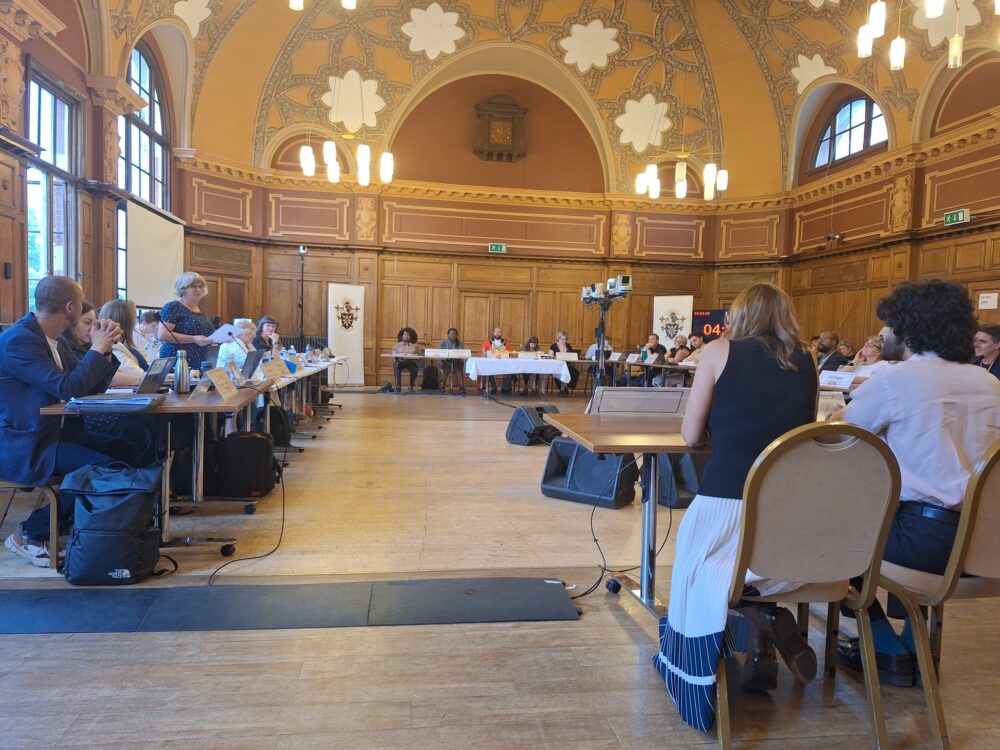
London, 22 July 2025 — Haringey Council has passed a unanimous motion officially recognising Latin Americans as a distinct ethnic group, joining a growing nationwide movement to make Latin Americans visible in public policy and data.
Haringey is home to the UK’s third-largest Latin American population, which has quadrupled between 2001 and 2021 based on country-of-birth data. However, without a dedicated ethnic category in the UK census, the true size of the community remains unknown.
Current estimates based on the UK Labour Force Survey put the Latin American population at around 450,000, but campaigners say this is a likely underestimate. As data only includes people born in Latin America — not second-generation UK-born Latin Americans or those born in Portugal or Spain. With plans to scrap the 2031 census now abandoned, advocates argue this is a critical moment to push for proper ethnic monitoring.
Haringey’s recognition comes as the Seven Sisters Market — a celebrated hub of Latin American culture in London—reopens for the first time since its closure in March 2020. After over 20 years of community organising, local traders, business owners and residents involved in the Wards Corner Community Plan have successfully stopped a corporate redevelopment and are now working in partnership with Haringey Council and Places for London on a community-led refurbishment of the Wards Corner site. This stands as a landmark victory for grassroots activism and a model in collaborative and democratic urban regeneration.
Jacobo Belilty, Coordinator of the Coalition of Latin Americans in the UK (CLAUK), explains:
“We welcome the decision of Haringey Council to recognise Latin Americans in the borough. This motion adds to a growing list of wins led by CLAUK members, community leaders and activists fighting for the Latin American identity since the historic success in Southwark in 2012 — the first UK borough to officially recognise Latin Americans as a distinct ethnic group. Other wins with local authorities include the Greater London Authority and London Boroughs of Hackney, Islington, Lambeth, Newham and Southwark. The support from Haringey is encouraging the coalition to continue promoting inclusion in ethnic monitoring across England, Wales and Scotland.”
Building on this milestone, CLAUK—a group of led-by-and-for organisations raising awareness of the needs and advocating for labour rights, civic participation and the inclusion of Latin Americans in UK policy— will continue to bring together communities around the issue of official recognition. In the legacy of the Latin American Recognition Campaign, CLAUK has been a core platform to advance this cause on behalf of the communities, and will continue to work with other stakeholders to recognise the Latin American identity in the UK.
“This motion is not just a local breakthrough — it is also the first step in a renewed national campaign led by the Coalition of Latin Americans in the UK, demanding that the Office for National Statistics include a ‘Latin American’ ethnic category in the 2031 Census,” he said.
Belilty explains: “Because Latin Americans aren’t recognised in the census, the true size of our community remains unknown — and the figures that do exist are likely significant underestimates. Latin Americans live in cities across the UK, not just in London — from Edinburgh and Glasgow to Liverpool, Manchester, Swansea, Swindon and Newcastle. We ask for a single ethnic group category that would tackle this statistical invisibility. This is a chance for the ONS to do what’s right: officially recognise our communities and finally count a whole generation of British-born Latin Americans who are missing from the data.”
Victoria Álvarez from the Wards Corner Community Plan and Chair of the Seven Sisters Market Tenants Association, says:
“We are proud that many years of organising have delivered a positive outcome for Latin Americans and the diaspora communities in the local area. We are setting an example in how vibrant cultural hubs such as the Latin Village can bring life to the future Borough of Culture.”
“Personally, I have been waiting for this moment for 35 years since I first arrived in the Borough. The market and the recognition of the Latin American identity are deeply significant to me and to the community of traders who are behind the Seven Sisters Market.”
Leader of the Council, Haringey Council, Cllr Peray Ahmet, says:
“This is a huge moment for the Latin American community in Haringey. Not only is the Seven Sisters Market re-opening, but they will soon be able to proudly identify as Latin American. We hope this will act as a springboard for the 2031 Census — which we will campaign for alongside CLAUK.”
“That we are in a position to say the Market is close to re-opening, with keys now in traders’ hands, is a remarkable achievement and testament most of all to the resilience and tireless campaigning of the market traders.”
“When I took over Haringey Council in May 2021, I was determined that the community’s voice would be heard. It’s been a long journey, but I’m so delighted that this iconic cultural landmark is back in business.”
Despite making vital contributions to the UK’s economy and culture, Latin Americans remain statistically invisible due to the absence of a dedicated ethnic category in official data. With an estimated half a million Latin Americans living in the UK, campaigners say invisibility is no longer sustainable. The Coalition of Latin Americans in the UK will continue to ensure the community is fully recognised in policy, data, and funding decisions ahead of the next census.
